
Article: Andalusia Mural
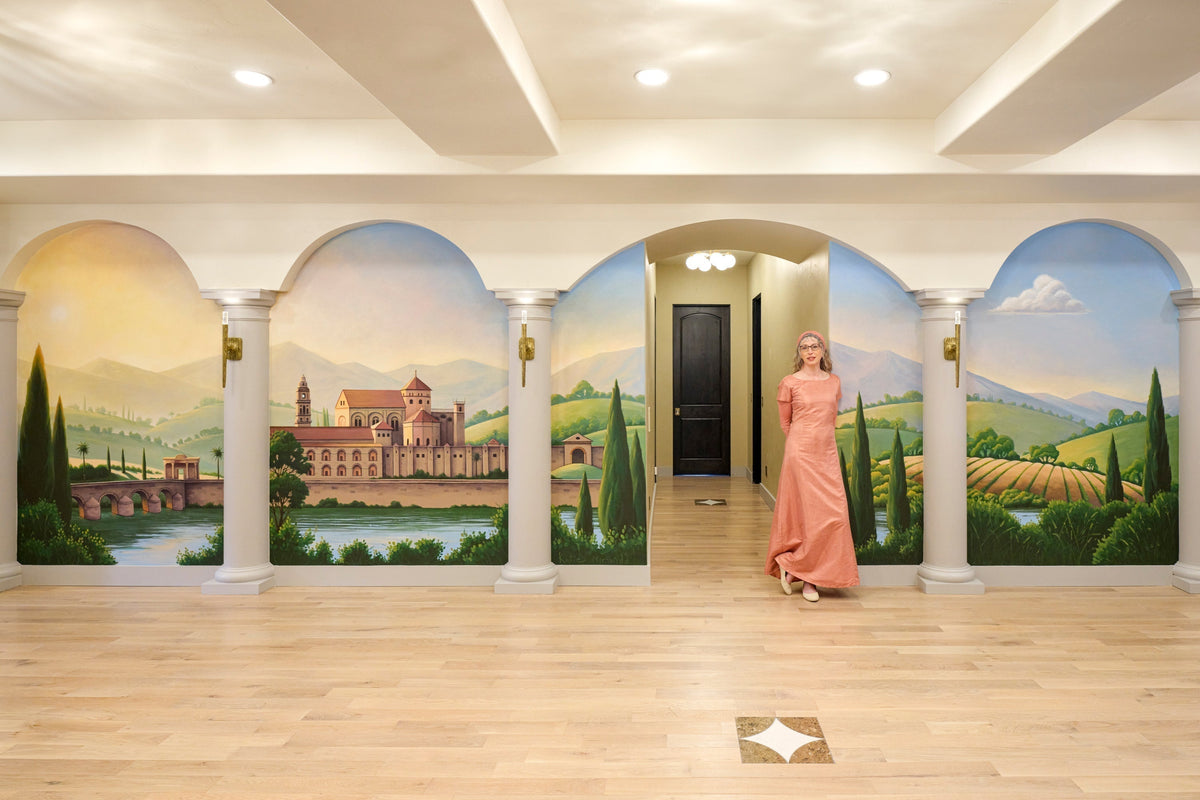
Andalusia Mural
The idea for this mural came from the client, a Portland, Oregon resident who wanted me to create something to honor his happy memories of vacations in Spain. He specifically wanted me to paint the Córdoba Mosque, the bridge leading to it, and the surrounding Sierra de Córdoba mountain range in the arches spanning this space.
before:

after: (click to view a larger version)

The arches are 5 feet 6 inches wide by 6 feet 5 inches tall, so this was a much larger painting than I was used to working on.
The general idea was to bathe the scene in golden light coming from the left side of the composition. I started by taking photos of the space, measuring the walls, and creating a sketch that put some of the general shapes in place.

The client wanted the individual panels to read as one continuous composition, with elements carrying across the spaces between the columns so that the entire mural felt connected rather than like a series of separate paintings.
I then researched different views and angles of the Córdoba Mosque and eventually settled on a composition that showed it lit by the setting sun coming from the left. The client particularly liked this sunlit view, and it also worked beautifully with the architecture of the room. A large door to the left of the mural allows natural light into the space, so the direction of the light in the painting is visually cohesive with the actual lighting in the room.
Next, I used the doodle grid method to transfer the design to the wall. Doodle grids provide a bit more flexibility than traditional horizontal and vertical line grids.

After that, I started blocking in the basic color shapes, paying close attention to the values. The term "value" in painting refers to the differences between lights and darks in an artwork. An artist can get the colors and proportions correct, but if the values are off, it can ruin the entire painting. Since a mural is often viewed from a distance, getting the values correct was critical in the early stages.

For me, this was also the point when the mural really started to come together. Once the values were accurate, the basic forms began to read correctly, and I could start building up the light, shadow, and details.
Across from the main mural, there is another arch in the room, and I decided to use it for a painting of the Castle of Almansa in Spain. The castle has architectural elements connected to the history of Islamic Spain, which fit perfectly with the theme of the main mural.

Although it isn't physically connected to the main mural, I wanted it to feel like part of the same world. I used the same general color palette, lighting, and painterly approach so that the two pieces would feel cohesive within the room.
I definitely like to add a lot of details, so once I was sure the values were correct, I added the light and shadow and began working in more of the details.
below: getting the values right and adding detail

Because this mural was created specifically for the room, I also paid close attention to the colors already present in the space. I went through the room with a color fan deck and selected accent colors that would tie the painting into the existing interior. For example, I incorporated copper and gold to echo the fixtures, and used yellow to complement the muted ochre walls. The brighter colors in the mural lighten up the room.

The result is a mural that isn't simply an image of Spain placed on a wall. It was designed specifically for this space, taking into account the architecture, existing colors, natural light, and the client's vision. This is one of the things I love about creating large-scale original artwork for a home: the painting can become part of the architecture and feel as though it belongs there.

I love creating custom paintings because they allow me to combine a client's vision with the character of the space where the artwork will live. For this mural, I brought together the client's memories of Spain, the architecture and colors of his home, and my own approach to light, atmosphere, and detail. The result is a completely original work designed specifically for the space—something you simply can't get with a print or wallpaper.


2 comments
You are so talented
Britta S Slopianka
Gorgeous!! Absolutely gorgeous!
Shannon Smith
Leave a comment
This site is protected by hCaptcha and the hCaptcha Privacy Policy and Terms of Service apply.